Bangalore's Urban Magic: Where Steel, Green, and Light Collide
You know that feeling when a city surprises you? Bangalore isn’t just India’s tech hub—it’s a visual playground. Think glass towers wrapped in ancient trees, murals breathing life into concrete, and golden light hitting skyscrapers just right. I’ve chased sunsets across rooftops, wandered through hidden garden alleys, and found frames everywhere. This isn’t just travel—it’s shooting the soul of a city transforming before your eyes. For the thoughtful observer, especially those who appreciate quiet beauty amid urban rhythm, Bangalore reveals itself in layers. It’s a place where progress doesn’t erase the past, and nature doesn’t retreat—it adapts, persists, and often, outshines.
The Unexpected Aesthetic of a Tech Capital
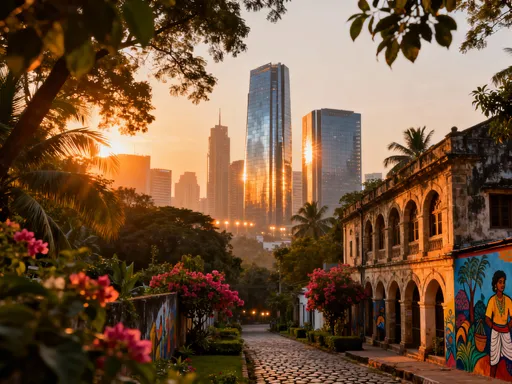
Bangalore defies the typical narrative of a fast-growing Indian metropolis. While cities like Mumbai or Delhi often feel like they’ve traded green for gray, Bangalore maintains a delicate balance between innovation and inheritance. Skyscrapers rise beside centuries-old banyan trees, their roots gripping stone walls like nature’s own architecture. Office parks glow with LED lights, yet within the same compound, peacocks still strut across manicured lawns. This coexistence isn’t accidental—it’s embedded in the city’s identity. Originally known as Bengaluru, the city was once celebrated as the 'Garden City of India,' a title it still honors, even as silicon circuits now hum beneath its surface.
For the photographer, this duality is a gift. Urban photography in Bangalore isn’t about capturing stark contrasts for dramatic effect; it’s about noticing harmony in the unexpected. A fiber-optic cable runs alongside a temple’s stone carving. Solar panels sit atop a colonial bungalow with ivy crawling down its walls. These are not clashes—they are conversations. The city invites you to look closer, to appreciate how modernity and memory can share the same frame. What makes Bangalore particularly compelling is that its growth feels organic rather than imposed. Unlike planned cities with rigid grids, Bangalore evolved in patches, allowing older neighborhoods to retain their character while new developments weave around them.
Because of this layered development, every district offers a different visual language. In Koramangala, converted homes host trendy cafes beneath neem trees. In Whitefield, glass-fronted tech campuses open onto jogging tracks lined with frangipani. These spaces aren’t just functional—they’re photogenic by design. The city’s planners, architects, and residents have maintained green buffers, public parks, and tree-lined avenues, ensuring that even in high-density zones, nature remains visible. For women aged 30 to 55, many of whom value balance, comfort, and meaningful experiences, Bangalore offers a rare urban environment where growth doesn’t come at the cost of serenity. You don’t need to escape the city to find peace—you can discover it within it.
Iconic Skylines with a Local Pulse
The skyline of Bangalore tells a story of evolution. It doesn’t tower like New York’s or shimmer like Dubai’s, but it speaks in quieter tones—of transition, adaptation, and layered history. One of the best places to witness this is around UB City, a luxury complex in the heart of the city. By late afternoon, the sun slants across its curved glass facade, reflecting streaks of amber and rose into the streets below. Standing at the junction of Vittal Mallya Road and Brigade Road, you can capture the convergence of old and new: vintage Ambassador cars pass beneath digital billboards, while pedestrians in traditional sarees walk past fashion boutiques with minimalist storefronts.
MG Road, once the main artery of colonial Bangalore, has transformed into a bustling commercial corridor, yet its heritage buildings remain. The white stucco walls and arched windows of 19th-century structures now house bookstores, tea stalls, and art galleries. When photographing this stretch, try using a wide-angle lens to include both architectural details and street life. Early morning is ideal—around 7:00 to 8:30 AM—when the streets are still calm, the light is soft, and vendors are setting up their stalls. You’ll catch moments of daily rhythm: a flower seller arranging marigolds, an elderly man reading the newspaper on a park bench, delivery bikes weaving through quiet traffic. These scenes add humanity to the cityscape, grounding grand architecture in lived experience.
For a more elevated view, head to the upper levels of nearby parking structures or heritage buildings with public access. The Karnataka State Central Library, located at the edge of Cubbon Park, offers a vantage point where you can frame the green canopy of the park against the rising towers beyond. Use a mid-range zoom lens (70–200mm) to compress distance and emphasize the layering of textures—leafy treetops, red-tiled roofs, and steel-and-glass towers in the background. Golden hour, just before sunset, casts a warm glow that softens the city’s edges, turning concrete into something almost poetic. If you’re traveling with family or prefer a relaxed pace, these spots are easily accessible and safe, offering both visual reward and comfort.
Green Oases in the Concrete Maze
No visit to Bangalore is complete without spending time in its legendary green spaces. Lalbagh Botanical Garden and Cubbon Park are not just recreational areas—they are essential characters in the city’s visual narrative. Lalbagh, established in the 18th century by Hyder Ali and expanded by his son Tipu Sultan, spans nearly 240 acres of curated flora, glass conservatories, and shaded pathways. The centerpiece is the iconic glasshouse, inspired by London’s Crystal Palace. Modeled after the Victorian structure, it hosts flower shows twice a year, drawing thousands. But even on ordinary days, the glasshouse glimmers under sunlight, its iron framework casting intricate shadows on the ground—an ideal subject for pattern-focused photography.
Within Lalbagh, the diversity of plant life offers endless framing opportunities. Tall palms rise beside flowering jacarandas, their purple blooms scattering across stone paths in spring. Ancient banyans spread their aerial roots like natural sculptures. Early morning light filters through the canopy, creating pools of brightness and shadow. Use a polarizing filter to enhance the contrast between green foliage and blue sky, especially on slightly overcast days when the light is diffused. For women who appreciate tranquility and natural beauty, Lalbagh is more than a park—it’s a sanctuary. You can walk for hours without feeling rushed, pausing to photograph a dew-covered spiderweb or a langur resting on a branch. It’s a place where time slows, and the lens becomes a tool for mindfulness.
Cubbon Park, located in the administrative heart of the city, offers a different kind of green rhythm. Laid out in 1870 by British horticulturist John Cubbon, the park is a grid of wide, tree-lined avenues shaded by rain trees, gulmohars, and silver oaks. Government buildings surround it, yet inside, the atmosphere is hushed and serene. The park is especially photogenic during monsoon, when the grass turns a vivid emerald and mist hangs in the air after rainfall. Paths become reflective surfaces, doubling the image of trees and sky. A tripod can help capture these mirror-like effects with long exposures. Early risers will enjoy the sight of senior citizens practicing yoga, children feeding ducks at the small pond, and couples strolling along the central promenade—gentle moments that speak to the city’s everyday grace.
Both parks change with the seasons, offering new compositions throughout the year. In summer, the intense light creates sharp contrasts; in winter, a soft haze lends a dreamy quality to images. Photographers should plan visits around these shifts, adjusting white balance and exposure to match the mood. These green spaces are not just backdrops—they are active participants in Bangalore’s urban story, proving that cities can grow without losing their soul.
Street Art & Architectural Texture
Beyond its parks and skylines, Bangalore’s neighborhoods reveal another dimension of visual richness—its streetscapes. Areas like Basavanagudi, Malleswaram, and Indiranagar are treasure troves of texture and color. In Basavanagudi, a historic residential zone, you’ll find traditional South Indian homes with sloping red-tiled roofs, carved wooden doors, and courtyards filled with potted plants. Many of these homes have stood for generations, their walls bearing the marks of time—peeling paint, moss growth, and hand-painted nameplates in Kannada script. These details, often overlooked, are gold for close-up photography. A macro lens can reveal the intricate grain of weathered wood or the delicate pattern of a brass door knocker.
Meanwhile, in Indiranagar and Koramangala, street art has transformed blank walls into open-air galleries. Local and international artists have painted vibrant murals depicting everything from mythological figures to abstract geometry. One famous piece shows a girl flying a kite made of constellations; another portrays a tiger emerging from a circuit board—symbolic of Bangalore’s blend of tradition and technology. These murals are best photographed in mid-morning light, when the sun is high enough to illuminate the entire wall but not so harsh that it creates glare. Use a neutral density filter if shooting in bright conditions to retain color depth.
When photographing residential areas, it’s important to be respectful. Avoid pointing your lens directly into homes or private spaces. If you see people in the frame, a simple smile or nod can go a long way in building rapport. In some cases, asking permission before taking a detailed shot of a home or person is both courteous and wise. Bangalore’s residents are generally welcoming, especially when they sense genuine appreciation for their surroundings. For women traveling alone or with children, these neighborhoods are safe and walkable, with plenty of small cafes and shops where you can rest between explorations.
The combination of old architecture and modern art creates a dynamic visual dialogue. A 100-year-old mansion might have a neon-lit café on the ground floor, its sign glowing beside a hand-carved pillar. This layering tells a story of continuity—of families preserving heritage while embracing change. As a photographer, you’re not just documenting buildings; you’re capturing the spirit of a community that values both memory and progress.
Elevated Perspectives: Rooftops and Observation Decks
To truly understand Bangalore’s scale and rhythm, you need to rise above the street level. While the city lacks dedicated observation decks like those in global metropolises, it offers alternative vantage points through rooftop cafes, shopping malls, and public buildings. One of the most accessible is the top floor of the Forum Mall in Koramangala, which opens to a semi-outdoor terrace with views of the surrounding neighborhood. On weekends, families gather here, and the atmosphere is lively yet relaxed. Position yourself near the railing with a wide-angle lens to capture the patchwork of rooftops—solar heaters, satellite dishes, laundry lines, and potted plants—each telling a small story of domestic life.
For a more serene experience, try the rooftop garden at the National Gallery of Modern Art (NGMA), located off Raguvanahalli Main Road. This quiet space overlooks a wooded area and offers panoramic views of the city’s southern edge. It’s particularly beautiful at sunset, when the sky shifts from gold to lavender. The gallery itself hosts rotating exhibitions, making it a cultural as well as visual destination. Since it’s a public institution, photography is permitted in outdoor areas, though flash may be restricted indoors. This makes it an ideal spot for women who enjoy combining art appreciation with photography.
Safety and permissions are important when seeking high vantage points. Avoid entering restricted areas or trespassing on private buildings. Instead, choose establishments that welcome visitors—many rooftop cafes in Indiranagar and Church Street operate during daylight and early evening hours. Places like Skyye Lounge or AER on the 35th floor of the UB Tower offer stunning views, though they may require reservations or have entry fees. For those who prefer a more budget-friendly option, public libraries or university campuses often have upper floors with windows facing the city.
From above, Bangalore reveals its rhythm—traffic flowing like veins, pedestrians moving in clusters, and lights flickering on as dusk falls. A tripod and a shutter speed of 10–30 seconds can capture light trails from vehicles, turning busy intersections into glowing ribbons. These long exposures transform chaos into elegance, showing the city’s pulse in a single frame. For women who appreciate both beauty and order, these elevated views offer a sense of clarity—a reminder that even in complexity, there is pattern and purpose.
Light, Weather, and the Bangalore Vibe
Bangalore’s climate is one of its most underrated assets for photography. With an average elevation of 900 meters, the city enjoys a mild, temperate climate year-round. Unlike the harsh, direct sunlight of Delhi or the humidity of Chennai, Bangalore’s light is often soft and diffused, especially on cloudy or partly overcast days. This natural diffusion acts like a giant softbox, minimizing harsh shadows and allowing for balanced exposures. Even at midday, when the sun is highest, the light rarely feels oppressive. This makes the city particularly welcoming for photographers who prefer consistent, forgiving conditions.
The monsoon season, which runs from June to September, brings a unique atmosphere. Frequent rains leave the air clean and the greens intensely vibrant. After a shower, mist often rises from the parks and lakes, wrapping trees and buildings in a silvery veil. This is an excellent time for moody, atmospheric shots. Use a lens hood to protect against splashes and carry a microfiber cloth to wipe your gear. A waterproof bag is essential, but most mirrorless and DSLR cameras can handle light drizzle if used carefully. Winter, from December to February, brings occasional haze, especially in the mornings. While this can reduce visibility, it also adds a dreamlike quality to cityscapes, blurring distant towers into silhouettes.
One of the joys of photographing in Bangalore is learning to work with these subtle shifts. Unlike destinations with predictable golden hours, Bangalore’s light changes in nuanced ways. Cloud cover can shift within minutes, creating fleeting moments of perfect illumination. Being prepared means keeping your camera ready, even when the sky looks dull. A polarizing filter can cut through haze and deepen blue tones, while a UV filter helps protect the lens in dusty or humid conditions. For women who value preparedness and practicality, packing a lightweight rain cover, extra batteries, and a compact tripod ensures you can shoot comfortably in any weather.
The city’s microclimates also mean that conditions can vary from neighborhood to neighborhood. It might be drizzling in Jayanagar while the sun shines in Whitefield. This unpredictability keeps photography exciting—it rewards patience and adaptability. Rather than chasing perfect light, you learn to embrace the mood of the moment. A rainy afternoon in Cubbon Park can be more evocative than a flawless sunset. The key is to stay present, observant, and open to surprise.
From Click to Story: Curating Your Bangalore Series
Taking photos is only the beginning. The true art lies in shaping them into a story. Bangalore offers so many visual elements—greenery, architecture, light, texture—that a curated series can convey deeper meaning. Start by choosing a theme. Is it contrast? Then pair a close-up of a peacock feather with a reflection of a skyscraper in a puddle. Is it coexistence? Show a grandmother selling flowers beside a digital payment sign. Is it transformation? Capture a colonial building being restored, scaffolding wrapped around its ornate facade. These themes help unify your work, turning random snapshots into a narrative.
When editing, aim for authenticity. Avoid over-processing—excessive saturation or sharpening can distort Bangalore’s natural tones. Stick to subtle adjustments: slight exposure correction, gentle contrast enhancement, and white balance tuned to preserve the city’s earthy palette. If you’re creating a print series or digital album, sequence the images to guide the viewer’s eye—start with wide shots, move to details, and end with a powerful closing image, like the glasshouse at Lalbagh bathed in morning light.
Bangalore is more than a destination; it’s a living canvas. It invites you not just to observe, but to engage—to see how growth and grace can coexist, how tradition and innovation can inspire one another. For women who seek meaningful travel, who value beauty with depth, the city offers a quiet kind of magic. It doesn’t shout; it whispers. And if you listen through your lens, you’ll hear it clearly—a story of balance, resilience, and enduring charm.